Hello! I am Marisa Blake Szubryt, a PhD Candidate at the School of Biological Sciences, Oklahoma Biological Survey, and Robert Bebb Herbarium at the University of Oklahoma. My dissertation focuses on the evolution of Heterotheca (Asteraceae: Astereae) known colloquially as “false goldenasters”, “camphorweeds”, and “telegraphweeds.” The genus is endemic to North America with greatest diversity in arid and semi-arid regions of the southwestern United States. Many narrow endemics occur within this area, with several occurring in only one or a few counties (ex. H. monarchensis). Other species, including H. grandiflora and H. subaxillaris s.l., have become prominent invasives globally in countries such as Argentina, Australia, Chile, Hawaii, Morocco, and Palestine.
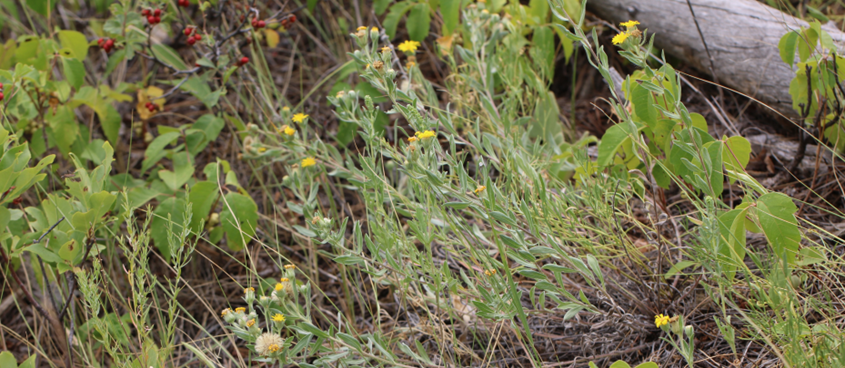
Species and varieties in this region exhibit considerable variation in life cycles, growth forms, edaphic specializations, climatic tolerances, floral displays, and vestiture. These transitions have enabled Heterotheca to diversify into ~70 taxa in only a few million years. The genus consists of three major clades (Ammodia, Heterotheca, and Phyllotheca), with the majority of species belonging to section Phyllotheca that includes radiate perennials. The specific mechanisms behind speciation in the genus, however, remain understudied. Given that virtually all species bloom from July to September and generally have similar DYC (“darned yellow composite”) floral displays, one might expect hybridization to occur rampantly in Heterotheca.
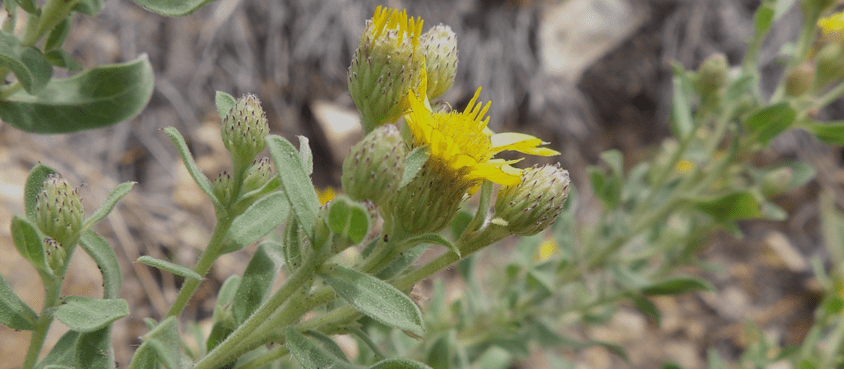
Indeed, pervasive hybridization has been hypothesized to explain the presence of morphologically intermediate or ambiguous plants. As most species as traditionally defined are sympatric with other species, many believed that introgression occurred frequently. Species rarely occur syntopically, however, limiting the potential for hybridization. While natural hybrids have been found with both parent species present (ex. H. canescens and H. scabrifolia produce H. angustifolia), genuine F1 or F2 hybrids have been infrequently recorded. Most putative hybrids, instead, represent examples of the high infra-specific morphological variation found within most speices, similar to oaks (Quercus).
 MBS (Molecular Biology & Systematics)